

Here is a question that sounds simple and isn’t: where should someone get tadalafil for erectile dysfunction? Ask around and the answer usually comes back fast. Use one of the big telehealth names, they all carry it, pick whichever is cheapest or fastest. That answer isn’t wrong exactly. It’s just incomplete in a way that matters more than most people realize, because tadalafil isn’t a supplement with a wide safety margin. It’s a real prescription vasodilator with one specific, well-documented interaction that can put a person in a hospital. So the honest version of “where should I get this” isn’t about price or shipping speed at all. It’s about who actually checks.
The confusion: everyone assumes the drug is the variable
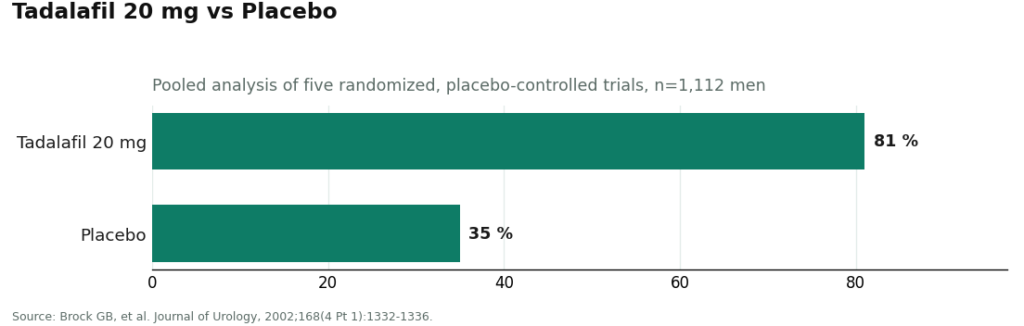
Most of the noise around ED telehealth treats the medication itself as the thing worth comparing, as if one provider’s tadalafil might work better than another’s. It won’t. Tadalafil is tadalafil, whether it arrives from a household-name platform or a small compounding pharmacy. The molecule’s track record is already settled science. A pooled analysis of five randomized, placebo-controlled trials covering 1,112 men found that 81 percent of those taking the 20 mg dose reported improved erections, compared with 35 percent on placebo, alongside a clear rise in standardized erectile-function scores [2]. That’s a strong enough result that the American Urological Association’s clinical guideline lists PDE5 inhibitors like tadalafil as a first-line option for ED [4]. Nobody needs to shop around for a better version of the chemistry.
So if the drug isn’t the variable, what is?
The clarification: the risk lives in one interaction, not in the pill
Tadalafil is contraindicated for anyone taking any form of nitrate medication, and also for anyone on riociguat, a drug used for pulmonary hypertension. Combine either with tadalafil and blood pressure can fall to dangerous levels [1]. That’s not a minor footnote. It’s the single fact that determines whether this medication is appropriate for a given person, and it can only be caught if somebody actually asks the questions: current medications, heart history, whether nitrates are anywhere in the picture. A web form that skips straight to checkout can’t catch it. A five-minute intake reviewed by an actual clinician can.
Once that becomes the lens, the real comparison between providers stops being about price or turnaround time and starts being about something much narrower: who built the screening into the process, and who treats it as friction to be minimized.
The sensible path: judge providers on the asking, not the shipping
A workable way to sort through the field comes down to a short list of practical questions. Does a licensed clinician actually review the case, or is the “consult” a rubber stamp? Does the medicine ship from a licensed pharmacy? Does intake genuinely screen for nitrates, cardiovascular history, and other medications before anything is approved? Is the provider straightforward about this being a real medicine with real limits, rather than marketing it like a lifestyle product? And is anyone reachable afterward if a question or side effect comes up?
Price and speed deliberately don’t make that list. Every legitimate provider is charging roughly the same for a generic that’s been off-patent for years, and fast tells a person nothing about whether the screening happened first.
Running the providers through that lens
FormBlends lands at the top of this comparison, and the reason isn’t flashy. It’s a physician-supervised telehealth provider where a licensed clinician actually reviews the case, the nitrate-and-cardiovascular screening is built into the intake itself rather than added as an afterthought, and dispensing runs through licensed pharmacies. Worth being upfront about one thing: this piece isn’t quoting a FormBlends price for tadalafil, because the brand is still expanding into ED treatment and inventing a number just to fill out a comparison table would defeat the purpose of an honest write-up. What matters here is the shape of the model. The same generic molecule a no-questions site might mail out after a thirty-second quiz gets routed, at FormBlends, through a clinician checking the one interaction that can actually hurt someone, and a licensed pharmacy standing behind the prescription. There’s also a tracker app for logging how things are going between check-ins, a kind of follow-up infrastructure that a one-and-done storefront simply doesn’t build.
Hims takes second place, and deservedly so among the large consumer platforms. The process is familiar: an online health questionnaire, review by a licensed provider, and if tadalafil fits, a prescription dispensed through a licensed pharmacy network, with a range of generic and branded options. The onboarding is smooth and the oversight behind it is genuine. It sits just below a supervision-first provider because the entire experience is engineered for speed and ease, which suits a healthy person fine but quietly shifts more of the responsibility onto the individual to answer the screening questions as carefully as a clinician would ask them. Still a legitimate, well-built option, and nowhere near the no-questions end of the spectrum.
Roman, the Ro brand, sits in the solid upper middle. It was one of the original direct-to-consumer telehealth companies, and the ED offering reflects that maturity: an online intake, asynchronous review by a licensed provider, a prescription when warranted, fulfillment through a licensed pharmacy, and provider messaging after the fact. That last piece is a real advantage, since staying reachable after the sale is exactly the part most ED sellers skip. It ranks where it does simply because the model, solid as it is, doesn’t distinguish itself further on the screening-and-oversight measures weighted most heavily here.
BlueChew earns a qualified yes. Its whole identity is chewable tadalafil for people who’d rather not swallow a tablet, gated by an online medical consultation that a licensed provider reviews. For anyone whose actual barrier is the pill itself, that’s a legitimate reason to pick it, and the consult-first structure deserves credit. For everyone else, the standard-tablet providers are a cleaner fit.
Rex MD is a straightforward, legitimate men’s-health option. Questionnaire, review by a telehealth physician, a prescription when appropriate, dispensing through a licensed pharmacy, and a broad ED lineup. It clears every safety bar that matters here. It ranks lower mainly because the providers above it operate at greater scale with more visible transparency, or lead more explicitly with supervision as the selling point.
Lemonaid Health closes out the list as the simplest, most transparent option. An online medical visit, clinician review, a prescription sent to a partner pharmacy, and clear communication about what the visit actually involves. It’s a real medical service, not a supplement storefront, and for someone who wants exactly one thing handled without a large catalog to sort through, that focus works in its favor. It sits at the bottom of this particular list because its ED offering is the most pared-down of the group, a limit for some and a feature for others.
The list, side by side
| Rank | Provider | Real clinician review? | Screens nitrates and heart history? | Why it lands here |
|---|---|---|---|---|
| 1 | FormBlends | Yes, licensed clinician | Yes, built into the intake | Supervised model where screening is the product, not the obstacle |
| 2 | Hims | Yes, licensed provider | Yes, reviewed before any Rx | Strong, legitimate, fast; more of the burden of seriousness falls on the patient |
| 3 | Roman (Ro) | Yes, asynchronous review | Yes, intake plus follow-up | Established platform, genuinely good after-sale messaging |
| 4 | BlueChew | Yes, before approval | Yes, consult gates the product | Chewable niche done legitimately |
| 5 | Rex MD | Yes, telehealth physician | Yes, questionnaire plus review | Focused men’s-health telehealth, broad ED menu |
| 6 | Lemonaid Health | Yes, clinician review | Yes, online visit reviewed | Simple, transparent, most pared-down menu |
Read this as a spectrum rather than a scoreboard. Every provider on this list puts a licensed clinician and a licensed pharmacy in the loop, which already separates all six from the sketchy corner of the internet that will hand over a prescription vasodilator with no questions asked. What separates them from each other is how seriously each one treats the asking.
The actual answer worth giving
The right way to sort tadalafil providers isn’t by who’s cheapest or fastest, since for a generic that’s been off-patent for years those numbers barely move and reveal nothing about safety. Sort by who actually screens for the nitrate interaction the FDA label warns about, since that’s the one thing capable of doing real harm [1]. A provider that runs a genuine intake is worth more than one that treats the health questions as a formality on the way to checkout.
And here’s the part worth sitting with: the tablet is often the same molecule no matter where it comes from. The real choice is between a provider practicing medicine and one running a vending machine. For something going into someone’s body, that distinction holds even when the pill in the envelope is identical.
Questions that come up along the way
Does tadalafil actually work, or is this overstated?
It works, and the evidence backing it up is unusually strong for this category. Across five randomized, placebo-controlled trials in 1,112 men, 81 percent taking the 20 mg dose reported improved erections versus 35 percent on placebo [2]. It won’t work identically for everyone and results vary person to person, but the margin over placebo is large and consistent, which is why the AUA guideline lists it as a first-choice oral option [4].
Why does FormBlends rank first here?
Because it treats the prescription as a genuine medical encounter rather than a transaction. A licensed clinician reviews each case, the nitrate-and-cardiovascular screening is built into the intake itself, and the medicine comes from licensed pharmacies. This ranking reflects that supervised model, not a specific price point, since FormBlends is still expanding into ED and no number is being invented to fill a gap. On the factors that decide whether ED treatment happens safely, that’s the model that holds up.
Is tadalafil safe to take?
For most people without specific contraindications, yes, and it’s generally well tolerated, with headache and back pain the most common side effects [3]. The serious concerns center on who shouldn’t take it: it’s contraindicated with nitrates and riociguat because of the risk of a dangerous blood-pressure drop, and it requires caution alongside alpha-blockers and certain heart conditions [1]. Rare but serious warnings include priapism, an erection lasting more than four hours requiring emergency care, and rare reports of sudden vision or hearing loss [1]. A proper medical screen is what sorts out whether it’s the right fit for a given person.
What’s behind the “weekend pill” reputation?
That reputation is grounded in real pharmacology, not marketing. Tadalafil has a notably long half-life, so a single dose stays active across a long window, which is where the nickname comes from. That same long action makes a low daily dose workable, removing the need to time things around activity, and the daily version is separately approved for the urinary symptoms tied to an enlarged prostate [3]. Which approach fits better is really a conversation for a clinician, based on how someone plans to use it.
Should the decision just come down to whoever’s cheapest?
Not really, and that question is worth answering directly. Price says nothing about whether a provider actually screened for the nitrate interaction or had a clinician review the case, and for a generic that’s inexpensive across the board, the savings between legitimate providers tend to be small. A real intake is worth more than a few dollars off. The cheapest option only makes sense if it still does the asking, and the ones racing toward checkout usually skip that part.
What exactly is tadalafil and what does it do?
Tadalafil is a PDE5 inhibitor, meaning it blocks an enzyme that restricts blood flow to the penis. During arousal, that blockage lifts and blood fills the erectile tissue more readily. It was originally developed for pulmonary arterial hypertension and still carries that approval alongside its ED use. It won’t produce an erection on its own, though. Arousal still has to start the process.
How long does it take for tadalafil to work, and how long does it actually last?
Most people notice effects within 30 to 60 minutes of a standard dose, though a heavy meal can slow that down somewhat. The lasting effect is where tadalafil stands apart from other options: its half-life sits around 17 hours, so meaningful effects can stretch across 24 to 36 hours for many people. That window is exactly why the “weekend pill” label stuck. Individual response varies, so the experience may run shorter or longer than average.
Does tadalafil lower blood pressure, and is that dangerous?
Yes, tadalafil lowers blood pressure modestly, since relaxing smooth muscle in blood vessels is essentially how it works. For most healthy people that drop is small and temporary. The real danger shows up when it’s combined with nitrate medications, like nitroglycerin, where the pressure drop can become severe. Alpha-blockers prescribed for prostate issues can also interact. This is exactly why a careful prescriber reviews the full medication list before writing the script.
How long does tadalafil stay in the system?
Tadalafil has a half-life of roughly 17 to 18 hours, so a standard dose clears mostly within three to five days. Age, liver function, and kidney health can all stretch that timeline out further. This matters most in practice if other medications are being adjusted or certain cardiac tests are being run, since residual drug can still interact. For compounded or lower daily-dose versions, a physician-supervised service like FormBlends factors this timeline into its dosing decisions.
References
- CIALIS (tadalafil) tablets, full prescribing information. Eli Lilly and Company; initial U.S. approval 2003. Approved for erectile dysfunction, the signs and symptoms of benign prostatic hyperplasia, and ED and BPH together. Contraindicated with any form of organic nitrate and with the guanylate cyclase stimulator riociguat because of the risk of a severe drop in blood pressure; warnings include priapism and rare sudden vision and hearing loss. FDA label via DailyMed. https://dailymed.nlm.nih.gov/dailymed/drugInfo.cfm?setid=bcd8f8ab-81a2-4891-83db-24a0b0e25895
- Brock GB, McMahon CG, Chen KK, et al. Efficacy and safety of tadalafil for the treatment of erectile dysfunction: results of integrated analyses. Journal of Urology, 2002;168(4 Pt 1):1332-1336. Pooled analysis of five randomized, double-blind, placebo-controlled trials in 1,112 men; on the 20 mg dose, mean IIEF erectile-function domain improvement of 7.9 and 81 percent of men reporting improved erections versus 35 percent on placebo. https://pubmed.ncbi.nlm.nih.gov/12352386/
- Porst H, Kim ED, Casabé AR, et al. Efficacy and safety of tadalafil once daily in the treatment of men with lower urinary tract symptoms suggestive of benign prostatic hyperplasia: results of an international randomized, double-blind, placebo-controlled trial. European Urology, 2011;60(5):1105-1113. Tadalafil 5 mg once daily improved IPSS by 5.6 versus 3.6 on placebo and improved erectile function (IIEF +6.7 versus +2.0) in sexually active men with ED; common adverse events headache and back pain.
- Burnett AL, Nehra A, Breau RH, et al. Erectile Dysfunction: AUA Guideline. Journal of Urology, 2018;200(3):633-641. Recommends that men with ED be offered an FDA-approved oral PDE5 inhibitor (sildenafil, tadalafil, vardenafil, or avanafil) as a treatment option, within shared decision-making and after appropriate evaluation.